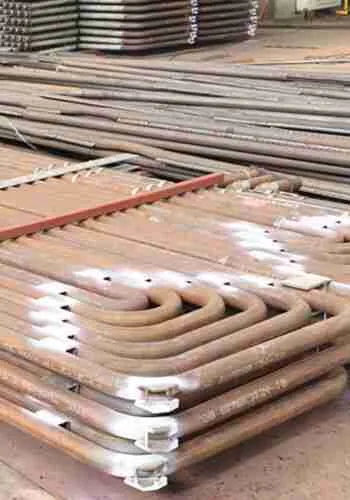
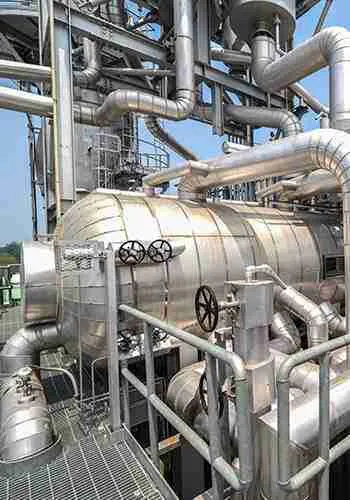
The re heater is a critical high-temperature heat exchange component in thermal power plant boilers. Typically operating in tandem with the super heater, it serves as a core configuration for high-parameter, large-capacity thermal power units. Its primary function is to secondary-heat the exhaust steam from the high-pressure (HP) cylinder of the steam turbine, optimizing steam thermodynamic parameters. This effectively enhances overall plant cycle efficiency and ensures the safety of main equipment, making it widely utilized in various modern, large-scale thermal power generating units.
1. Core Working Principle of the Re heater
During unit operation, high-temperature, high-pressure steam generated by the boiler enters the HP cylinder of the steam turbine to expand and perform work. As a result, the steam pressure and temperature drop significantly, approaching a saturated state. At this stage, the steam not only suffers from low residual heat utilization but is also highly prone to precipitating microscopic water droplets, which can cause severe erosion and impingement on subsequent steam turbine blades.
The re heater redirects this low-temperature exhaust steam from the HP cylinder back into the boiler flue gas pass. Utilizing the residual heat of the flue gas, it reheats the steam back to the unit’s rated temperature. The reheated steam is then directed into the intermediate-pressure (IP) and low-pressure (LP) cylinders of the steam turbine to continue expanding and performing work, completing a comprehensive reheat cycle. This cycle fully recovers flue gas waste heat, upgrades steam quality and work capacity, and significantly boosts the overall thermal efficiency of the power unit.
2. Main Classifications and Layout Characteristics
Based on heat transfer methods, structural designs, and installation locations, re heaters can be classified into several types to adapt to boilers of different capacities and parameters.
(1) Classification by Heat Transfer Method
Convective Reheaters: The most widely applied type, positioned within the convective flue gas pass of the boiler. They rely on convective heat transfer from the flue gas to heat the steam. Characterized by stable steam temperature and excellent load adaptability, they meet the operational needs of most large-scale utility boilers.
Radiant Re heaters: Positioned inside the furnace, they utilize flame radiation for heat exchange. They feature rapid temperature rise and high heat transfer efficiency but are highly sensitive to unit load fluctuations, making temperature control more challenging.
Radiant-Convective Combined Re heaters: The mainstream choice for modern units, blending both designs to balance high heat transfer efficiency with operational stability.
(2) Classification by Structure and Layout Location
Horizontal Re heaters: Positioned at the tail of the flue gas pass, they offer excellent drainage performance. This effectively prevents water accumulation inside the tubes, thereby avoiding tube corrosion and facilitating smooth unit startup and shutdown operations.
Vertical Re heaters: Arranged vertically, they feature a compact structure, high space utilization, and superior vibration resistance, making them ideal for compact boiler layouts.
System Process Variations (Single vs. Double Reheat): Systems are divided into single-reheat and double-reheat processes. Double-reheat technology, which upgrades steam quality through two sequential reheating stages, further elevates cycle efficiency. It is primarily applied in state-of-the-art, million-kilowatt-class ultra-supercritical (USC) units.
3. Key Structural Components
The re heater contains no moving parts, offering high operational reliability and a straightforward design. It consists primarily of:
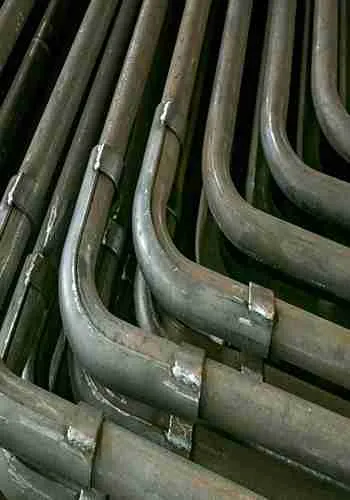
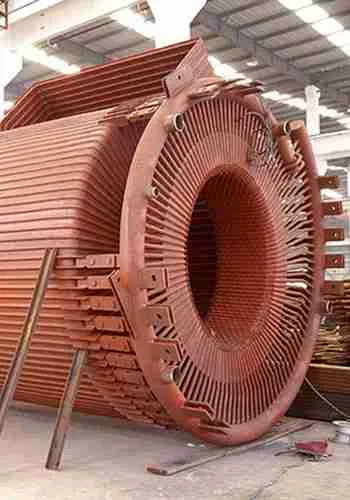
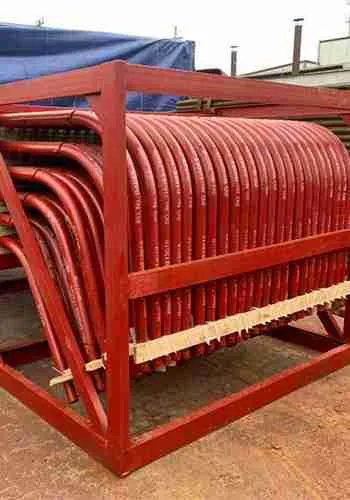
Serpentine Tube Bundles: Fabricated from alloy materials featuring high-temperature resistance, high-pressure resistance, and corrosion resistance. The serpentine configuration drastically expands the heat transfer surface area to guarantee thermal efficiency.
Inlet and Outlet Headers: Responsible for uniformly distributing and collecting steam, which effectively prevents uneven flow distribution among individual tubes and localized overheating.
Connecting Pipelines & Fixed Support Devices: The support devices securely stabilize the tube bundles against flue gas impingement, preventing pipeline vibration and mechanical wear.
Structural Note: Compared to boiler super heaters, re heaters operate under much lower pressure. Consequently, they utilize a design featuring larger tube diameters and thinner walls. This design minimizes steam flow resistance and prevents heat transfer deterioration under low-pressure conditions, ensuring a stable and reliable heat exchange process.
4. Core Functions and Application Value
(1) Elevating Cycle Efficiency and Reducing Generation Energy Consumption
Steam upgraded through the reheating process possesses significantly enhanced work-performing capacity, allowing for more thorough expansion within the steam turbine and drastically minimizing waste heat losses. According to thermodynamic statistical data, for every 1°C increase in reheat steam temperature, the plant cycle thermal efficiency improves by approximately 0.25%. This effectively lowers coal consumption per unit of power generated as well as carbon emissions, boosting both the economic and environmental performance of the unit.
(2) Reducing Exhaust Moisture and Protecting Steam Turbine Equipment
The exhaust steam at the final stage of the LP cylinder features low temperature and pressure, making it highly susceptible to condensing into liquid water droplets. High-speed water droplets continuously impact and erode the blades, leading to blade deformation, cavitation damage, shortened equipment lifespan, and increased maintenance costs. Re heaters effectively raise steam dryness and reduce exhaust moisture, mitigating blade erosion at its root cause, ensuring long-term safe operation, and reducing forced outages.
(3) Stabilizing Operating Conditions and Broadening Unit Adaptability
The reheat cycle effectively dampens the impact of unit load fluctuations on steam parameters, enhancing operational stability under transient or variable load conditions. Simultaneously, incorporating a reheat system allows for a moderate reduction in the boiler’s main steam pressure. This relieves the structural load on pressure-retaining components such as the boiler, pipelines, and valves, lowering manufacturing and O&M (Operations and Maintenance) difficulties, and providing robust support for the large-scale deployment of high-parameter thermal power units.
5. Operational Challenges and Control Methods
In practical operations, re heaters face two major technical challenges:
High Temperature Sensitivity: Due to low working pressure and low thermal inertia, reheat steam is exceptionally sensitive to temperature changes. Minor fluctuations in coal quality, load, or flue gas volume can easily trigger steam over temperature incidents.
Tube Degradation Risks: The relatively low steam velocity inside the tubes limits heat transfer intensity. This makes the components vulnerable to defects such as tube slagging (clinkering), high-temperature oxidation, and flue gas corrosion, which accelerate pipeline aging over long-term operation.
To achieve precise and stable regulation of reheat steam temperature, power plants collaboratively deploy multiple control methods, including tilting burners, flue gas damper adjustment, and flue gas re circulation. Concurrently, engineering measures—such as adopting high-performance corrosion-resistant and heat-resistant tube alloys, optimizing tube bundle layouts, and installing anti-wear shielding devices—are implemented to mitigate equipment failures and extend service life.
6. Future Technology Trends
Driven by the thermal power industry’s shift toward high efficiency, low carbon, and intelligence, several trends are shaping the future of re heater technology:
Widespread Adoption of Double-Reheat: Double-reheat technology is becoming standard in ultra-supercritical units, continuously pushing the limits of thermodynamic cycles to further suppress power supply coal consumption and carbon emissions.
Advanced Materials: Next-generation alloys featuring superior high-temperature resistance, anti-oxidation, and corrosion resistance are progressively replacing traditional tube materials. These advanced materials can withstand higher steam parameters and harsher flue gas environments, substantially improving equipment reliability.
Intelligent Operations: Leveraging high-precision sensors and big data analytic, smart control systems enable real-time monitoring and automated adjustment of tube wall temperatures, steam parameters, and flue gas conditions. This perfectly aligns with the operational demands of deep peak-shaving and frequent load cycling.
Modularization and Compact Design: The promotion of modular and compact structural configurations helps minimize the equipment footprint while reducing manufacturing, installation, and O&M costs.
7. Conclusion
As the core equipment for improving efficiency and quality in thermal power thermodynamic cycles, the re heater leverages its simple structure and high operational reliability to solve key industry pain points, such as low cycle efficiency and high equipment degradation rates in traditional thermal power generation. It seamlessly balances economic performance with operational safety. Against the backdrop of the global low-carbon energy transition, the continuous optimization and iteration of re heater technology serve as a vital technical guarantee for thermal power units to achieve highly efficient, flexible operations and integrate into next-generation power systems, maintaining its irreplaceable role in the thermal power sector.