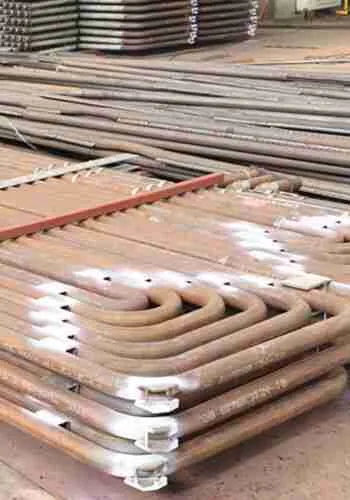
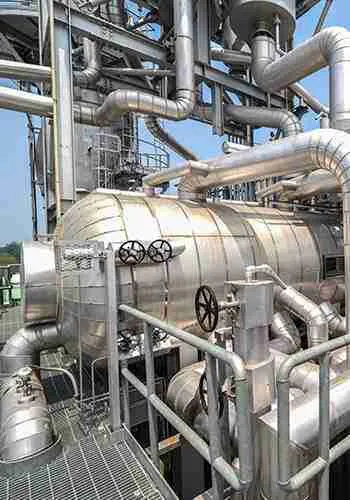
In industrial boilers and thermal power plants, the steam drum (or boiler drum) is the most critical high-pressure, load-bearing component of natural circulation boilers. Often referred to as the “heart” of the steam-water loop, it sits at the top of the furnace structure, physically and operationally linking four primary heat-exchange surfaces: the economizer, downcomers, water walls, and superheater.
Equipped with internal separation, chemical dosing, and blowdown systems, and flanked by external safety instrumentation, the steam drum manages the entire lifecycle of steam-water circulation, steam purification, and parameter monitoring. It is the ultimate linchpin for ensuring safe, stable, and highly efficient boiler operations.
1. Establishing Natural Water Circulation
The steam drum serves as the primary distribution hub and boundary point for the boiler’s hydrodynamic loop.
The Flow Path: Subcooled feedwater from the economizer enters the drum $\rightarrow$ It mixes with existing boiler water and descends through the unheated downcomers $\rightarrow$ It enters the furnace water walls, absorbing intense radiant heat to generate a two-phase steam-water mixture $\rightarrow$ This low-density mixture rises back up into the drum.
The Efficiency Advantage: This entire loop is driven entirely by the density differential between the cooler water in the downcomers and the boiling mixture in the water walls. This establishes a robust natural circulation loop without requiring high-maintenance, power-hungry circulation pumps, significantly reducing auxiliary power consumption (plant power).
Thermal Demarcation: The drum acts as the strict dividing line between the evaporative heating surfaces and the superheating surfaces, routing dry saturated steam to the superheater to complete a fully closed, high-efficiency thermal circuit.
2. Advanced Steam-Water Separation and Quality Control
The two-phase mixture returning from the water walls carries high concentrations of moisture and dissolved solids (salts). Allowing this unpurified mixture into the steam header triggers disastrous cascading failures:
Superheater Tube Failures: Deposition of solids causes localized overheating, leading to rapid tube deformation and eventual rupture.
Turbine Degradation: Solid carryover creates severe erosion and scale buildup on steam turbine blades, destroying aerodynamic profiles and severely degrading overall unit efficiency.
The Internal Multi-Stage Purification Barrier
To mitigate this, the drum utilizes a rigorous multi-stage mechanical separation process. Cyclone or chevron separators combined with corrugated scrubber plates utilize centrifugal force and surface impingement to knock out bulk moisture. This is paired with an internal steam washing device that traps and dissolves residual vaporized silica and salts, lowering steam humidity to optimal levels and shielding critical downstream assets.
3. Thermal and Hydraulic Buffering Against Load Fluctuations
Containing large inventories of both saturated water and saturated steam, the drum functions as a giant thermal flywheel. This inherent energy storage provides an invaluable buffer against volatile grid demands or sudden industrial process changes:
Sudden Load Spikes (The Swell Effect): When steam demand abruptly rises, the localized pressure drops. This causes the high-temperature water inventory to rapidly flash into steam, temporarily compensating for the demand deficit and arresting a sudden drop in system pressure.
Sudden Load Drops (The Shrink Effect): When demand plummets, the drum acts as a thermal sink, absorbing excess thermal energy and suppressing dangerous overpressure spikes.
This ample fluid buffer dampens erratic water-level fluctuations, shielding the feedwater control valves from constant, aggressive cycling and stabilizing the entire combustion control loop.
4. In-Drum Water Chemistry and Blowdown Management
Even highly treated, demineralized feedwater contains trace amounts of impurities. Due to continuous, high-frequency evaporation, these impurities concentrate rapidly in the drum water, threatening the integrity of the boiler tubes through scaling and corrosion. The steam drum serves as the primary deployment point for chemical control:
Continuous Blowdown (Surface Blowdown): Continuously skims and discharges the highly saline water from just below the drum’s operational water level, maintaining total dissolved solids (TDS) within strict chemical limits.
Chemical Dosing & Periodic Blowdown: Phosphate-based conditioning agents are continuously injected directly into the drum to react with residual hardness, converting calcium and magnesium into loose, non-adherent sludge. This sludge settles to the lowest points of the boiler circuit and is intermittently purged via bottom/periodic blowdown, preventing hard scale from insulating the water walls.
5. Centralized Safety Monitoring and Interlock Protection
As the highest-pressure vessel within the steam generator boundary, the drum accommodates a comprehensive, redundant suite of safety instruments:
| Instrument / System | Primary Operational Function |
| Water Level Gauges (Bi-color / Differential Pressure / Hydrastep) | Provides redundant, real-time visual and electronic monitoring of the critical water level line. |
| Pressure Transmitters | Feeds live pressure data directly to the automated combustion control loop. |
| Safety Valves & Emergency Blowdown Valves | Provides mechanical and automated overpressure relief or rapid water evacuation during emergency high-water excursions. |
These instruments are hardwired directly into the plant’s DCS (Distributed Control System) and MFT (Main Fuel Trip) interlocks. If parameters cross critical safety thresholds, the system automatically executes an emergency shutdown, preventing catastrophic drum overpressure, dry firing, or turbine water induction.
6. Critical Operational Safeguards
Boiler operators must rigorously manage two primary operational risks associated with steam drums:
I. Flawless Water Level Management
Low Water Levels: Can cause hydraulic stagnation or downcomer starvation. Without constant water flow, the water walls will experience rapid dry firing and catastrophic thermal rupture within minutes.
High Water Levels: Induces severe mechanical carryover (priming). Slugs of liquid water entering the superheater can cause thermal shock, and if water enters the steam turbine, it will cause water hammering, destroying blades and thrust bearings almost instantly.
II. Thermal Stress and Fatigue Mitigation
Because steam drums feature incredibly thick carbon steel walls, they are highly susceptible to severe thermal gradients during startup (heating) and shutdown (cooling).
Unequal heat transfer rates create a top-to-bottom and inner-to-outer wall temperature differential. Operators must strictly restrict temperature ramp rates—typically keeping the differential below 50°C—to prevent massive localized thermal stress, which can manifest as fatigue cracking around the drum shell, welds, and nozzle penetrations.
Maintenance Tip: During planned plant outages, internal separation baffles, chemical distribution headers, and blowdown lines must be thoroughly inspected for structural integrity, erosion, and nozzle plugging to ensure optimal flow dynamics.
7. Summary
The steam drum is far more than a passive reservoir; it is a highly engineered, dynamic reactor that drives natural circulation, guarantees steam purity, buffers erratic load swings, and anchors the boiler’s entire automated safety loop. Achieving safe, economical, and ultra-long asset lifecycles ultimately relies on the uncompromising, precise control of three baseline variables: drum water level, operating pressure, and structural wall temperature.